















 Panzer Dragoon Orta Panzer Dragoon Orta |
Developer: Smilebit | Publisher: Sega |


 |
Type: Action | |
Players: 1 |
| Difficulty: Intermediate | Released: 01-14-03 |
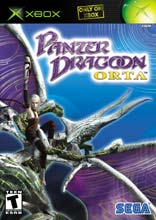 Panzer Dragoon Orta sees release at a time when shooters no longer command the attention of the gaming public. Movies like Star Wars once popularized the genre, providing opportunities to relive the excitement of taking on a Death Star or some passable simulacrum in a single ship. Gamers weaned on The Lord of the Rings and the disappointment of the new Star Wars trilogy no longer enjoy the vicarious thrill of launching one-man assaults against enormous space armadas. They have since gravitated to other thrills, and only a minority continues to enjoy the traditional 2D shooter. Panzer Dragoon Orta sees release at a time when shooters no longer command the attention of the gaming public. Movies like Star Wars once popularized the genre, providing opportunities to relive the excitement of taking on a Death Star or some passable simulacrum in a single ship. Gamers weaned on The Lord of the Rings and the disappointment of the new Star Wars trilogy no longer enjoy the vicarious thrill of launching one-man assaults against enormous space armadas. They have since gravitated to other thrills, and only a minority continues to enjoy the traditional 2D shooter.
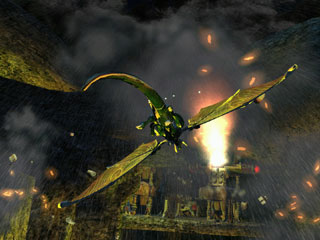
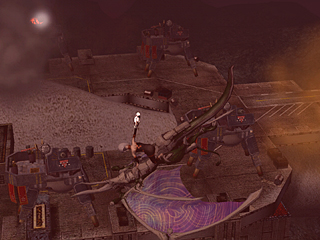
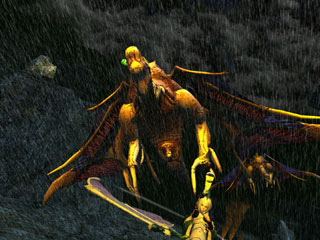
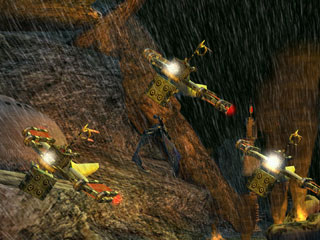
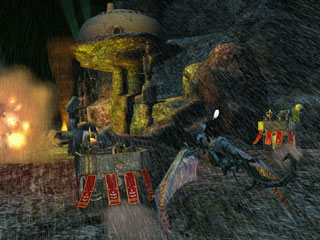
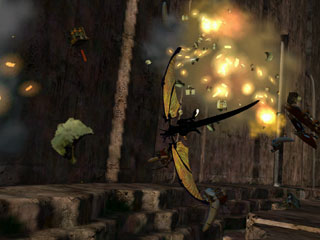
When it debuted on the Saturn in 1995, Panzer Dragoon aimed to be a "next-generation" shooter, infusing the classic genre formula with state-of-the-art graphics and sound in an effort to recapture the attention of gamers. While the game was quite advanced and breathtaking, it was also short and simplistic. It was at the same time too esoteric for casual fans and too simplistic for the hardcore. Though its sequels expanded on the gameplay, even taking it in RPG-like directions, the whole series felt under-realized and underdeveloped. The rich game world inspired by the esoteric French sci-fi artist Moebius demanded a more powerful gaming platform. Panzer Dragoon Orta is Sega’s latest attempt to restore the shooter genre to the forefront of the industry, and it admirably attempts to capture the imagination of the post-Star Wars generation while remaining challenging and true to its roots. The game takes place in a distant fantasy world where ancient technology coexists with outlandish fantasy. Orta, the game’s protagonist, is a mysterious girl freed from a prison by a peculiar dragon during a raid on a village outpost. As if compelled by some unknowable destiny, Orta climbs on board this dragon. You control her as she and the dragon fight against a corrupt Empire and the evil forces behind it. Orta plays just like the previous Panzer Dragoon games (save possibly Saga, which I haven’t played) with a few significant tweaks. It’s an on-rails 3D shooter not unlike Space Harrier, another Sega classic: press the fire button quickly to fire Orta’s laser pistol, or hold down the button to fire the dragon’s lock-on lasers. Here’s the twist; unlike Space Harrier, enemies attack you from all sides, and you can rotate your view 90 degrees at a time. So Orta is essentially a 360-degree shooter. Orta adds two new commands to the mix: morph and glide. The glide button lets you burst forward or backward, allowing for new maneuvering options and boss strategies. The morph button allows you to shift into three different dragon forms on command: Base Wing has average lasers and the highest number of possible lock-ons; Glide Wing has no lock-ons but has auto-targeting lasers, extra armor, and extra glide energy; Heavy Wing has the most powerful lock-ons, but it’s slow as hell and can’t glide. Shooting certain enemies will earn you powerups called Gene Bases, which will give you a jolt of health and allow you to increase the power level of your current dragon form. The latest edition of the Panzer series is the most intense yet. From the first level, expect to meet swarms of planes and veritable clouds of enemy fire. It is by no means an easy game. Think that massive battleship you fought at the end of the first level was tough? Later on, you’ll take on an entire fleet. You’ll face a diverse and astonishing array of opponents, from ancient war machines to gigantic flying manta ray-like creatures and many more that defy description. In each level, Orta ups the ante with more challenges in a gradual, satisfying way. There’s plenty of game here. The game lasts ten stages, and each is quite lengthy. And as anyone with two working eyes will tell you, this is one of the most gorgeous games to hit a home console. Even with hundreds of projectiles and complex textures on the screen at a time the game maintains 60 frames per second, never chugging or stopping to load. The level design is imaginative and varied, ranging from desert ruins to ancient temples to rivers teeming with exotic fauna. It’s a challenging game, too; even on the lowest difficulty level you can expect to die quite a few times, and the boss patterns force you to think. Fortunately, the game provides unlimited continues, allows you to save in-between levels, and even lets you continue at the end of a level once you’ve reached the boss. For the ultra-hardcore there are plenty of replay incentives; the game grades your performance on each stage, and per Panzer Dragoon tradition there’s a "Pandora’s Box" filled with unlockable goodies. In fact this is the most exhaustive Pandora’s Box yet; included are art galleries, encyclopedias, minigames, side scenarios, even the entire original Panzer Dragoon. If games were graded on graphics, sound and presentation alone, this would be a perfect game. The production values are high even compared to other top-tier Xbox titles. Not only is the game world exhaustively imagined visually, with towns constructed on the backs of sandworms and machines designed with such organic beauty that they truly look alive, but the characters speak a unique language specifically designed for the series (allegedly a fusion f German and Japanese). The soundtrack ranges from ethereal tribal sounds to techno-infused battle marches and complements the game’s primitive/futuristic aesthetic. And yet in spite of the increased challenge, the rich array of replay incentives, and the high production values, this is still largely the same Panzer Dragoon game Saturn fans played in 1995. Your movement is still restricted to a predetermined path even though you have a boost maneuver this time around. And because you have to move the targeting reticule and the dragon at the same time, control still feels slightly sluggish. For a game that aspires to be the next evolution in shooting games, Orta doesn’t provide the tight gameplay of older 2D shooters, and in that respect the series remains at the same level it was when Panzer Dragoon was first released. Ironically Orta’s atypically long length inhibits its replay value. I enjoy replaying 2D shooters because they’re quick to get through, often taking no more than fifteen to twenty minutes. But a single playthrough of Orta takes more than forty-five minutes, and each level is generally less frenetic than your average shooter. So although the first playthrough is more substantial and enjoyable to most gamers, its epic size does not lend itself to spur-of-the-moment gaming sessions. However the game is worth enjoying multiple times for the atmosphere alone, and those who enjoy the Panzer Dragoon universe will find plenty of replay value. So is this the next evolutionary step in the shooting genre? Yes, to the extent that it uses the computing horsepower of the Xbox to create an intense, challenging, engrossing, and unforgettable game. It doesn’t make 2D shooters obsolete, but it does succeed where its predecessors failed in striking a balance between total immersion on the one hand and total intensity on the other. In short, it’s the sort of game that will captivate action gamers of all ages, from the Star Wars era of action shooting and beyond. For a TNL interview with Panzer Dragoon project director Akihiko Mukaiyama, please click here. |
|
|
Graphics: 10 | |
Sound: 9 |
| Gameplay: 8 | Replay: 8 |
