



 |
 |
 |
 |












 DDRMAX: Dance Dance Revolution DDRMAX: Dance Dance Revolution |
Developer: Konami TYO | Publisher: Konami |


 |
Type: Rhythm | |
Players: 1 - 2 |
| Difficulty: Adjustable | Released: 10-29-02 |
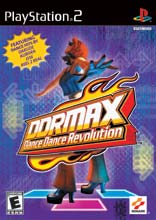 Dance Dance Revolution is quite possibly the most popular dance simulation game series on the market today. It all started in the arcades, where kids, teenagers, and adults alike stood in line waiting to try out the Dance Dance Revolution machine. Some people merely enjoy the occasional round of arrow-stomping fun, while some hardcore fans have formed their own clubs and get together on a regular basis to hog their local machine. Dance Dance Revolution is quite possibly the most popular dance simulation game series on the market today. It all started in the arcades, where kids, teenagers, and adults alike stood in line waiting to try out the Dance Dance Revolution machine. Some people merely enjoy the occasional round of arrow-stomping fun, while some hardcore fans have formed their own clubs and get together on a regular basis to hog their local machine.
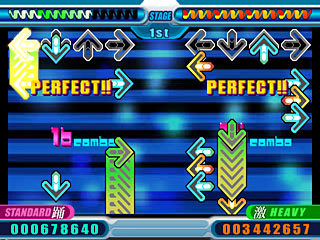
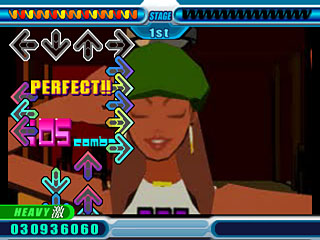
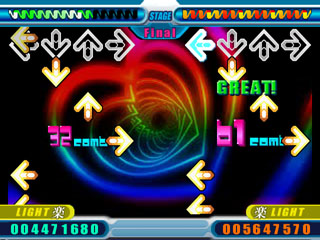
Eventually, the original Dance Dance Revolution was released for the PlayStation, making it easy for people to play the game at home without having to stand in line or deal with the potential embarrassment of dancing in front of a crowd. It wasn’t long before Konami released DDR: Konamix for the PlayStation. Konamix was basically the original DDR with a lot of new songs and a couple of new features. Finally, a new game has been released in the series, and this time, it’s for the PS2. DDRMAX is most definitely everything that made the original games great and much, much more. Unless you’ve been living in a cave for the past several years, you should know how to play a DDR game. But for all those cave people out there, here’s a brief description: A song plays in the background while arrows (up, down, left, and right) scroll up the screen. As they reach the top, you step on the corresponding arrow on your dance pad (or your controller, but that kind of defeats the purpose) to the beat of the music. Time your steps well and you’ll pass the stage. If you time them poorly, you’ll fail and have to try again. Basically, this is what Dance Dance Revolution is all about. There are a few more complicated step patterns, however, such as jumps (two arrows must be pressed at the same time) and freeze arrows. Freeze arrows are a new feature in the franchise, and they require the player to hold down a specific button for a certain amount of time. While all this is going on, an announcer is either complimenting or insulting you based on how well you’re doing. This tends to be more annoying than encouraging, but it’s a DDR tradition nonetheless. The song list in DDRMAX is enormous compared to former titles in the series. Over 65 songs are available, and some are exclusive to the U.S. release. The amount of available music is surprising enough at first, but as you play through the game, you’ll notice that many extra songs will become unlocked as well. A few old favorites (such as Brilliant 2U) are on the list, but the majority of the tracks are brand new. Many of the songs, such as I Like To Move It and Sandstorm, will be familiar even to those who don’t play DDR. Even if you aren’t a big fan of techno music, there’s no need to worry. So many music styles are included on the playlist that you’ll have a hard time finding a song that you don’t like. The graphics have most definitely been improved, thanks to the switch from the PSX to the PS2. The background graphics during gameplay are rendered and look great, but they really aren’t necessary. When you play DDR, you focus on the arrows and nothing more. If you don’t watch the arrows carefully and look at the pretty backgrounds instead, you’ll end up seeing the Game Over screen. Of course, the game would seem rather dull if the screen consisted of a black background with arrows going up the screen. Although the backgrounds look nice, they can sometimes be distracting when you’re trying to play a difficult level (or a level with a lot of bright colors and flashing lights). Either way, Konami has harnessed the power of the PS2 and the result is a great-looking game. DDRMAX does not introduce any new modes of play, but several improvements have been made to the old ones. The regular single-player and two-player modes each have four difficulty settings so that the game is easy enough to learn and challenging enough to keep the player interested. The unique Edit Mode, which lets players make their own step patterns for a song, is now much easier to use. Lastly, Workout Mode makes its appearance yet again, allowing players to burn calories while dancing to their favorite songs. For first-time players, DDR may seem a bit difficult. The best thing to do is to try out the helpful Training Mode, then play a single-player game on the easiest settings possible. Even then, you’ll need a bit of practice before you start getting the hang of it. Luckily, DDRMAX includes several options that prevent the game from being ridiculously difficult. On the other hand, seasoned players who want a challenge can raise the difficulty level and try out the insane Oni Mode. (It probably isn’t a coincidence that “oni” is Japanese for “devil.”) The best part of a DDR game is its replay value. These are the types of games that you can go back to again and again for years without getting bored. With over twice as many songs as either of the older titles and several modes of play, DDRMAX is a game that you won’t be selling or trading in anytime soon. If you liked previous installments, this game is an absolute must-buy. If you don’t like DDR, maybe you should give it a try anyway. DDRMAX is without a doubt the best game in the series thus far, so don’t hold back thinking that the sequel won’t be as good as the original. In this case, the sequel is the original, but with more of the options that made the original games so great in the first place.
|

|


|
Graphics: 8 | |
Sound: 10 |
| Gameplay: 9 | Replay: 10 |
